
Jonathan Silver and Herbert Matter
Tuesday and Friday, 12 - 5 pm
And by appointment
526 W 26th Street, Room 318
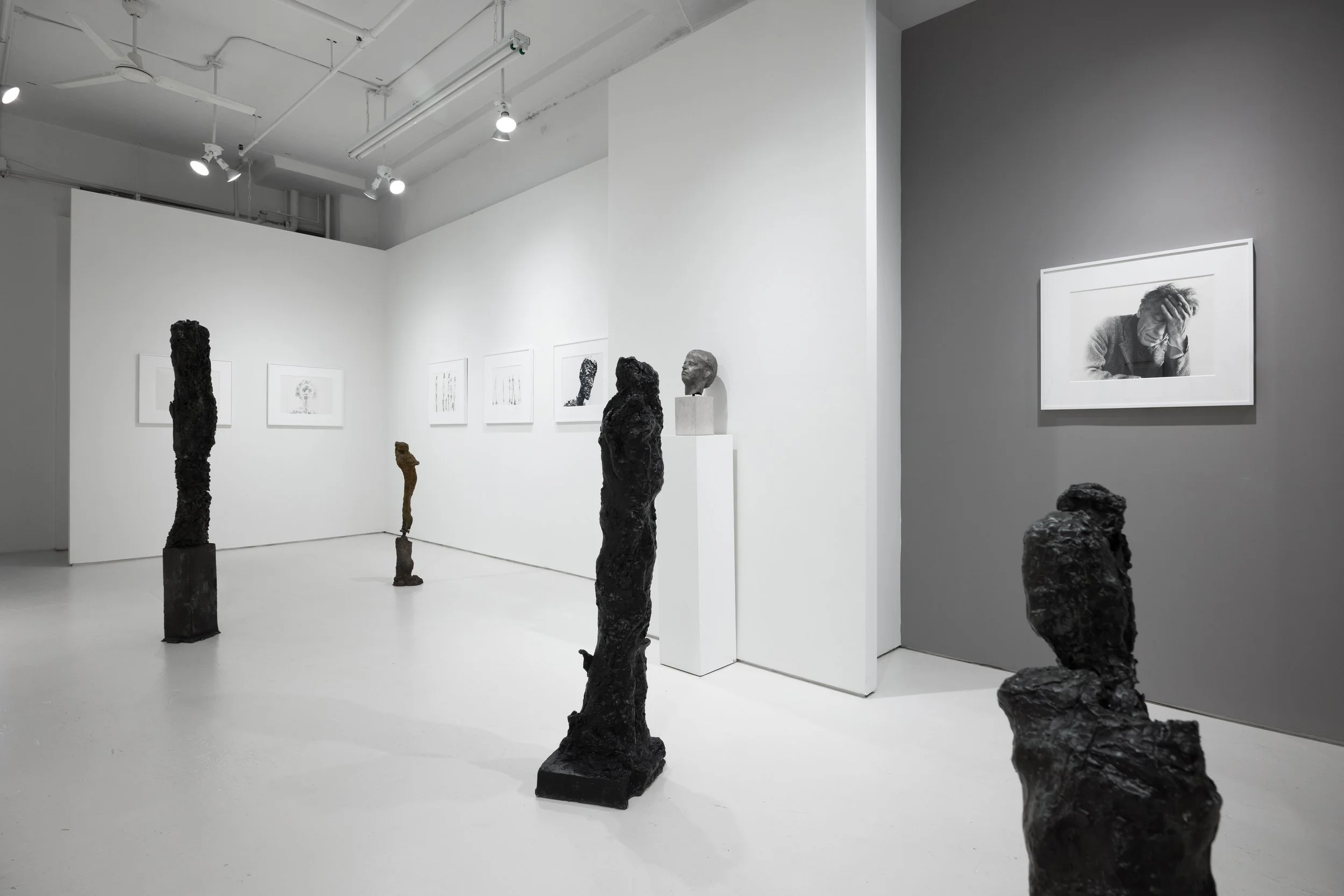
Nicole Klagsbrun is pleased to present Jonathan Silver and Herbert Matter, bringing together sculptures and drawings by American artist and art historian Jonathan Silver (1937–1992) with black-and-white photographs by Swiss-American photographer and designer Herbert Matter (1907–1984). Their distinct bodies of work enter into dialogue through sustained but fundamentally different engagements with Alberto Giacometti (1901–1966): While Matter revealed new dimensions of Giacometti’s sculpture through photography, heightening its frontality, material presence, Silver transformed Giacometti’s formal and psychological intensity within a fragmented and mythologically charged language of his own.
The presentation centers on the standing figure. Five of Silver’s bronzes—Diana (1987), Medea (1983), Orpheus and Eurydice (1983), St. Cecilia (1983), and Small Venus (1980)—are shown alongside graphite drawings dating from c. 1975 to c. 1992, in which the same narrow, upright form recurs. Thirteen photographs from Matter’s 1978 portfolio Thirteen Photographs: Alberto Giacometti and Sculpture—a portrait of Giacometti and twelve studies of his sculpture—extend this investigation to Giacometti’s own elongated figures, including Man Walking (1950), Standing Woman (1948), City Square (1948), Walking Man I (1959–60), and Seven Figures and a Head (The Forest) (1950).
Silver was a sculptor, art historian, writer, and teacher whose modernist lineage ran through Rodin, Medardo Rosso, Raymond Duchamp-Villon, and Giacometti. He pursued doctoral research on Giacometti’s painting at Columbia University under Meyer Schapiro before setting his dissertation aside in the early 1970s to make sculpture his primary practice. He later taught at the New York Studio School, founded in 1964 by Mercedes Matter (Herbert Matter’s wife).
Over the following two decades, Silver developed a figurative language in which Cubism served as a method of constructing, dismantling, and reconstructing the human figure—an inquiry grounded in his 1974 essay “Giacometti: Frontality and Cubism” and exemplified by the attenuated, segmented body of Small Venus (1980), featured in this exhibition. As sculptor Tom Otterness later observed in a filmed conversation with Michael Brenson, Silver cut, shifted, reversed, and reassembled cast fragments, using tensions between positive form and negative space to restructure the figure physically and psychologically. His work also drew on the compact mass of ancient Egyptian sculptural heads and the dramatic intensity of Hellenistic sculpture.
Silver’s early heads were modeled, fragmented, and reassembled into frontal constructions that invite unstable and often unconscious associations. In his mature standing figures, this psychological intensity expands into the entire body. Their titles draw upon classical, biblical, and mythological sources, but the works do not illustrate inherited narratives; they release myth into a fractured modern sculptural language. As critic Michael Brenson wrote in The New York Times in 1984, “Silver’s sculpture is steeped in classical and religious myth.” Brenson emphasized that Silver’s engagement with the past remained inseparable from his knowledge of modernism, particularly the formal and psychological implications of Cubism and Surrealism.
Matter met Giacometti in 1950 through their mutual friend Pierre Matisse, the influential New York dealer whose gallery served as a vital bridge between European modernism—including Surrealism—and American collectors and museums. He was subsequently commissioned to photograph Giacometti’s sculpture and design the catalogue for the artist’s first American museum exhibition, presented by the Solomon R. Guggenheim Museum in 1955. Matter continued photographing Giacometti and his work through 1965. Through staging, framing, lighting, and the shaping of each print in the darkroom, he intensified the sculptures’ frontality, isolation, material presence, and psychological charge. The resulting images operate not only as documents but as autonomous interpretations of sculpture through photography.
Matter worked for years on a monograph devoted to Giacometti, designing the book but leaving it unfinished at his death. Mercedes Matter saw the project through to publication by Harry N. Abrams in 1987. The volume includes her text, a foreword by Louis Finkelstein, and an introduction by critic Andrew Forge. Forge described Matter’s photographs as both acts of description and criticism and as works of imagination generated by the encounter between sculpture and photography.
Silver’s bronzes and Matter’s photographs meet most visibly in the standing figure and its vertical elongation. Small Venus, rising as a narrow column more than five and a half feet tall, shares the radical attenuation that Matter emphasizes in his photographs of Man Walking and Walking Man I. Yet this elongation functions differently across the two bodies of work: in Matter’s photographs, framing and light sharpen the precarious presence of Giacometti’s figures, while Silver transforms a related verticality into fragmented bodies whose drama is internal and psychological.
The presentation brings these two practices into focused dialogue. Both practices share a concern with frontality, fragility, material presence, and the enduring significance of the human figure. For Matter, Giacometti’s sculpture becomes the basis for an autonomous photographic image; for Silver, Giacometti’s lessons of frontality become a point of departure toward fragmentation, myth, and psychological interiority. Together, their works present the figure as a continuously renewed field of perception and experience.